Course Review: Brain Based Language Networks and Individual Differences
Last updated
June 16, 2026
Course Review: Brain Based Language Networks and Individual Differences
Name
Name
01
.
14
.
2026
4
min. read
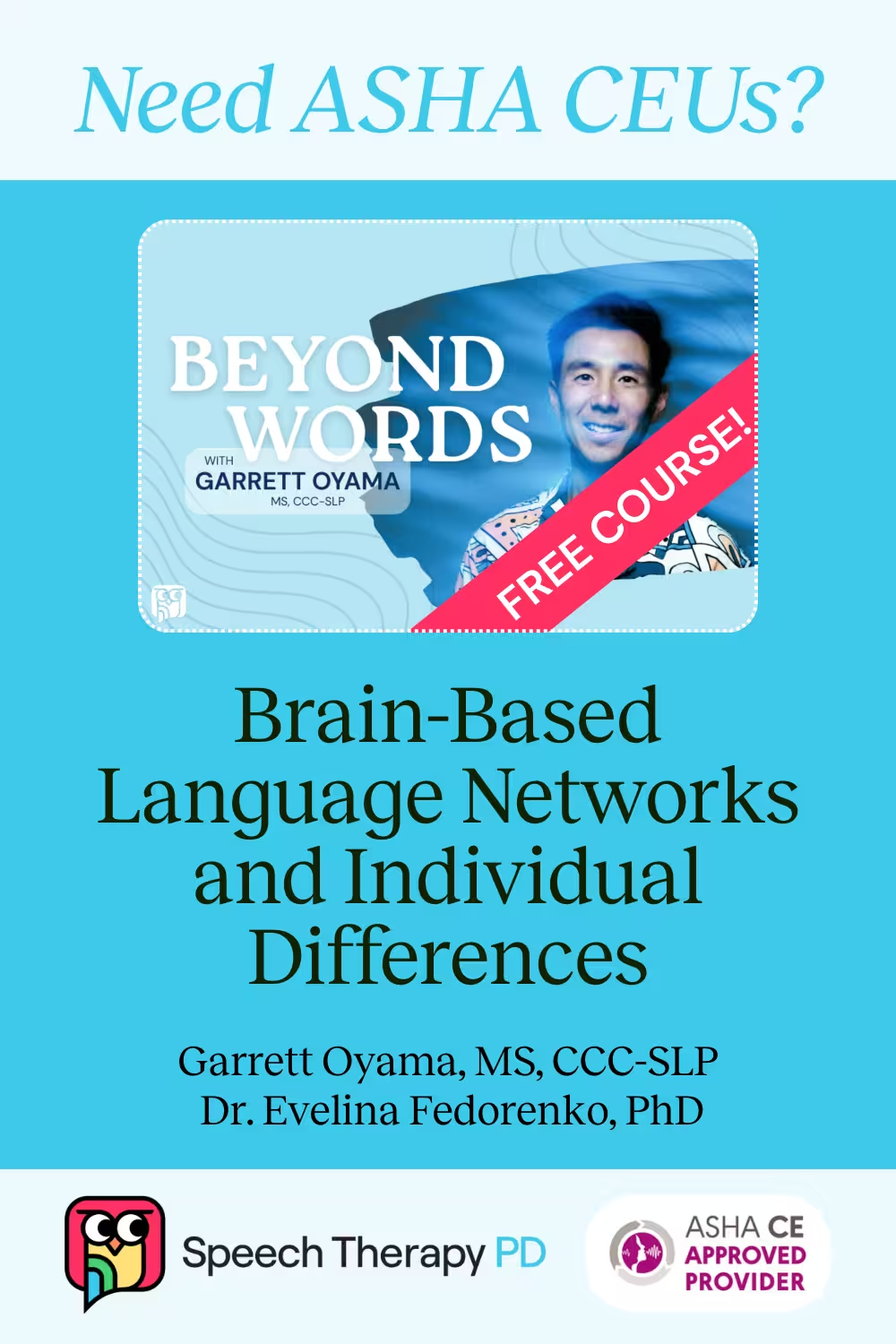
This podcast episode was truly the best course I’ve listened to for a professional development hour in 2025. Garrett’s podcast is high-quality and pulls from a range of disciplines. I wanted to share a course rundown Brain-Based Language Networks and Individual Differences with what I learned, what I loved, and who I think should take it. If you aren’t already subscribed to Speech Therapy PD, find my exclusive code at the end of this review to get this course at no cost.
Dr. Federenko is a cognitive neuroscientist who provided education that clarified and deepened how I think about my work. Ideas I have held since my graduate program were turned on their head, which was honestly exciting. Dr. Federenko clearly loves her work and explains enthusiastically, often using gesture & analogy to illustrate ideas. I really value PDs where I am intellectually challenged but can easily connect it to the kids in front of me.
What I Learned
You know I can be hyperbolic, but this was one of the most informative podcast episodes I have ever listened to. Some of my main takeaways were about the visual word form area, specific locations implicated in the processing stages of speech & language, and the ways that musical, phonemic, and mechanical sounds are handled by the brain (hint: not the same way). I was fascinated that semantic and syntactic processing are not considered distinct (the phrase “lexicalized syntax” stood out to me). Lastly, hearing a cognitive neuroscientist reference the Usage-Based Theory of Language by Tomasello had me nodding and smiling.
Who I Think Should Take This Course
I truly believe that all speech-language therapists should take this course. There is a prevailing idea that Broca’s means expressive and Wernicke’s means receptive, but this (like anything in the brain) is not that simple. I also think that a lot clinicians who are interested in Gestalt Language Processing don’t actually know much at all about what language processing entails. I, for one, have a profound amount to learn, and this episode has me feeling motivated to keep going.
If this topic interests you, I highly recommend listening to the episode on Speech Therapy PD. You’ll get CEUs for 2026, develop your confidence about the brain’s relationship with language, and perhaps be inspired to dig deeper. Once again, you can use my code GESTALT33 to get the CEU for free.