Advanced Knowledge, Skills, and Leadership in Child Language
Last updated
August 28, 2026
Advanced Knowledge, Skills, and Leadership in Child Language
Name
Name
07
.
23
.
2026
5
min. read
Advanced Knowledge, Skills, and Leadership in Child Language
As speech-language pathologists working with children and adolescents, we must always be at the top of our game regarding language intervention. Regardless of our work environment (school, private practice, clinic, medical, or university setting), children/adolescents must be successful in their daily lives, which includes their home, community, and school.
What We Know
As we are called to evidence based practice, the link from speaking and listening to reading and writing is well documented.
Language skills and literacy achievement are highly correlated; research consistently demonstrates that the more children know about spoken language, the better equipped they are to succeed in reading and writing (Burns et al., 1999, Mehta et al., 2005, Pennington et al., 2019).
Children with weak language skills at 15 months demonstrated greater difficulty with reading comprehension in 5th grade (Justice, Mashburn, & Petscher, 2013).
Speaking and listening can predict later literacy success (LervAag, et al, 2017).
Effective literacy instruction must include teaching that fosters oral language development, especially for students who enter kindergarten with weak spoken skills and English language learners (Calderon, 2011).
From Speaking and Listening to Reading and Writing
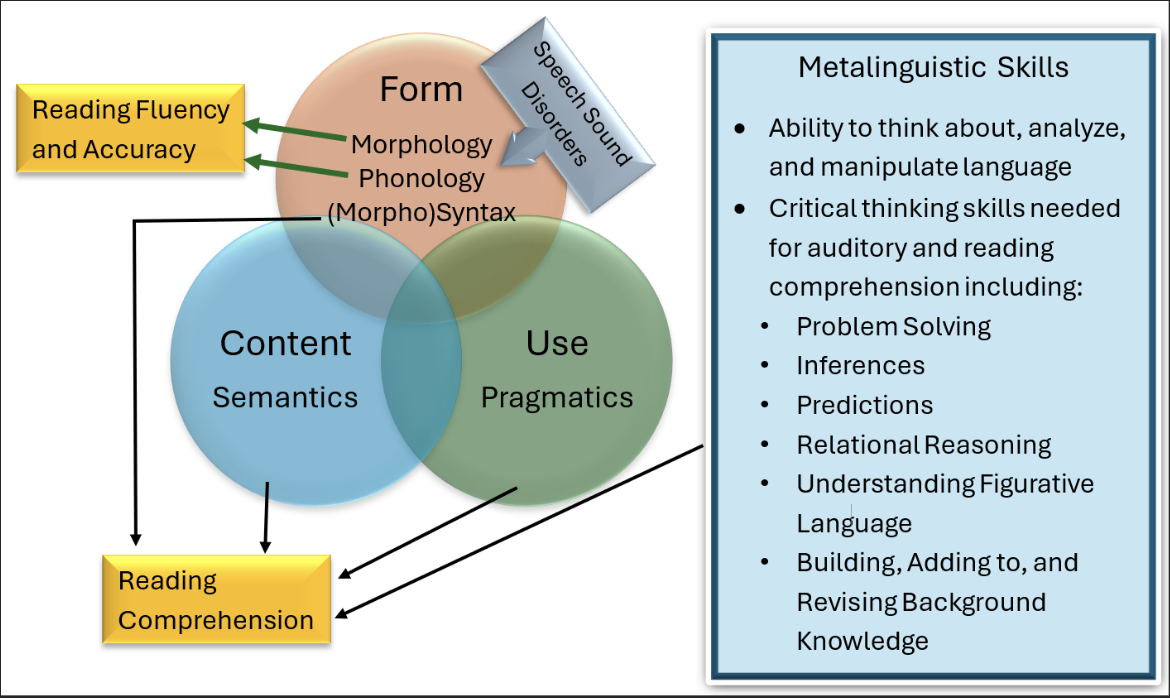
We need to go back to 1978! Bloom and Lahey defined the 5 domains of language (phonology, morphology, syntax, semantics, and pragmatics) as an integration of three intersecting components including the Form of the language including morphology, phonology, and syntax; the Content of language which encompasses semantics, and the Use of the language which is pragmatics. Language develops through the integration of these 5 domains. In addition to the integration of the language domains, we must also be cognizant of the importance and integration of metalinguistic skills. Metalinguistic awareness consists of an explicit understanding of various aspects of language.
Next, we can then overlay how these language (and speech sound) skills impact written language including reading and writing.
The following chart demonstrates the integration of form, content, use and metalinguistic skills and the importance of spoken language for written language.
Gaining Knowledge through Intermediate and Advanced Courses in Child Language
When we think about how language disorders present in the various populations that we serve and the impact that the language disorder has from spoken to written language, we realize that we must be lifelong learners! This comes from gaining experience, building and revising our background knowledge, and intermediate and advanced courses in child language. Our continuous learning demonstrates our dedication to the profession, the importance of quality of care, and validation of our skills and knowledge.
Speech Therapy PD is committed to offering the most up to date intermediate and advanced courses for child language and language disorders. From early intervention through adolescents, practical topics are presented by colleagues with expertise in various areas that will impact our intervention.
Board Certification in Child Language and Language Disorders
Through our commitment to continuing education and gaining experience, we can provide language intervention with the most up to date research and clinical knowledge. We also have the opportunity to be recognized as experts in child language and language disorders through The American Board of Child Language and Language Disorders (ABCLLD). ABCLLD is a nonprofit board recognized by the American Speech-Language-Hearing Association since 2000. In order to gain certification, one must have their CCC, at least 5 years of child/adolescent language experience, demonstrate advanced knowledge, skills, leadership, and clinical experience in child language as well as document 100 hours of intermediate or advanced continuing education related to child language within 10 years of applying for certification. Every 5 years after certification, board certification must be renewed with recording 100 clock hours of intermediate or advanced continuing education activities.
Speech Therapy PD is committed to providing courses and conferences including topics such as the neurological, cognitive, and linguistic aspects of language development, cultural and linguistic diversity, AAC, metalinguistic skills, social communication and play, family/teacher involvement, adverse child experiences and trauma, literacy, speech sound disorders as they impact language development, and issues related to neurodiversity. These intermediate and advanced presentations provide an avenue for increased knowledge as well as for initial certification and recertification for board certification in language and language disorders.
The opportunity to demonstrate the knowledge we gain through advanced courses is invaluable to those we are so fortunate to serve. From speaking and listening to reading and writing, those we serve can reach their limitless potential.
References
Bloom L, & Lahey M (1978). Language development and language disorders. John Wiley & Sons, Inc.
Burns, M.S., Griffin, P., Snow, C.E. (1999). Starting out right. Washington, DC: National Academy Press.
Calderón M, Slavin R, Sánchez M. Effective instruction for English learners. Future Child. 2011 Spring;21(1):103-27. doi: 10.1353/foc.2011.0007. PMID: 21465857.
Justice L, Mashburn A, Petscher Y. Very early language skills of fifth-grade poor comprehenders. Journal of Research in Reading. 2013;36:172–185. doi: 10.1111/j.1467-9817.2011.01498.x.
Lervåg, A., Hulme, C., Melby-Lervåg, M., Unpicking the Developmental Relationship Between Oral Language Skills and Reading Comprehension: It's Simple, But Complex, Child Development, Volume 89, Issue 5, September/October 2018, Pages 1821–1838, https://doi.org/10.1111/cdev.12861
Mehta P, Foorman BR, Branum-Martin L, Taylor WP. Literacy as a unidimensional multilevel construct: Validation, sources of influence, and implications in a longitudinal study in grades 1–4. Scientific Studies of Reading. 2005;9:85–116. http://dx.doi.org/10.1207/s1532799xssr0902_1
Pennington, B.F., McGrath, L.M. & Peterson, R. L. Diagnosing Learning Disorders: From Science to Practice. New York: Guilford Press. 2019.