Advances in Discourse Assessment and Intervention for Aphasia Conference
What Is Discourse?
For many people with aphasia, the real test of communication does not happen at the level of a single word or sentence. It happens in the moments that matter most: telling a story, joining a family conversation, explaining a problem, repairing a misunderstanding, asking a healthcare question, giving an opinion, or reconnecting with the people and activities that give life meaning.
These everyday exchanges are examples of discourse. In speech-language pathology, discourse refers to language beyond isolated words and sentences that is used for a specific communicative purpose – this is often spoken but can also be written. It includes storytelling, picture description, procedural explanations, personal narratives, interviews, persuasive or argumentative language, and spontaneous conversation. It may be monologic, as when one person tells a story or explains a process, or multi-party, as when a person participates in conversation with one or more communication partners. Discourse is also multimodal. People communicate meaning not only through words and sentences, but also through gesture, facial expression, prosody, writing, drawing, pointing, alternative and augmentative communication (AAC), and objects in the environment.
Why Discourse Matters in Aphasia Assessment
This broader view matters because aphasia affects communication in ways that are not always visible on traditional language tests, such as standardized batteries such as the Western Aphasia Battery – Revised or the Boston Diagnostic Aphasia Examination. For example, a person may name single pictures accurately but struggle to organize a personal story. Another person may produce short or effortful utterances but still communicate the main idea through gesture, facial expression, writing, and partner support. Someone with very mild or “latent” aphasia (aphasia that only shows up when sufficiently cognitively challenged) may score within normal limits on standardized measures while still experiencing slowed, incomplete, or poorly organized discourse that affects work, relationships, confidence, or quality of life. Discourse assessment allows clinicians to see how communication functions in real life, not just how language performs under isolated testing conditions.
The Evolution of Discourse Assessment
Historically, discourse has long been part of aphasia assessment, even when it has not always been labeled that way. Standardized aphasia batteries such as the Western Aphasia Battery and Boston Diagnostic Aphasia Examination include picture description tasks to evaluate connected speech. Over time, discourse research has expanded from a focus on microlinguistic features, such as word retrieval, paraphasias, syntax, pauses, and informativeness, to include broader features such as coherence, story grammar, topic maintenance, pragmatics, and conversational interaction. More recently, shared databases, common protocols, automated tools, perceptual rating systems, and discourse-focused treatments have helped move discourse science closer to everyday clinical practice.
Understanding the Different Levels of Discourse
One helpful way to think about discourse is as a multilevel structure. At the linguistic level, SLPs may consider vocabulary, syntax, word errors, lexical diversity, utterance length, or speech rate. At the propositional level (typically, utterance-level), clinicians may examine whether the person is communicating meaningful ideas, linking concepts clearly, and providing enough information for the listener. At the macrostructural level, clinicians may look at global organization, story structure, sequencing, gist, and coherence. At the pragmatic level, clinicians may consider turn-taking, topic maintenance, contextual appropriateness, repair, and partner interaction. A multimodal lens adds another essential layer by recognizing how gesture, facial expression, prosody, writing, drawing, and AAC support communication.
Identifying Both Strengths and Challenges
For clinicians, this matters because discourse can reveal both breakdowns and strengths. A person with aphasia may have reduced lexical diversity, shorter utterances, impaired cohesion, or difficulty organizing a narrative. At the same time, they may preserve the emotional point of a story, use gesture effectively, recognize a listener’s needs, repair misunderstandings, or communicate better in familiar contexts than in structured testing. These preserved abilities are not secondary details; they are often the foundation for meaningful, participation-focused treatment.
The Influence of Cognition and Context
Discourse is also shaped by cognition and context. Attention, working memory, executive function, processing speed, fatigue, emotional demands, and environmental noise can all influence how well a person communicates across turns and ideas. A client may describe a simple picture relatively well but struggle to retell an unfamiliar story. They may communicate effectively in a quiet one-on-one setting but have difficulty in a fast-paced group conversation. They may understand what they want to say but need extra time to organize, produce, or repair the message. For SLPs, this means discourse assessment should not focus only on language accuracy. It should also consider task demands, supports, partner behavior, and the real-world conditions in which communication succeeds or breaks down.
A Fit-for-Purpose Approach to Assessment
This is why discourse assessment is best understood as a “fit-for-purpose” process. In this model, which I describe in a forthcoming American Journal of Speech Language Hearing Pathology Clinical Focus article, the clinical question should guide the task, the measure, and the interpretation. If the goal is to understand word retrieval and sentence production, a structured picture description may be useful. If the goal is to understand how a person explains important health information, a procedural or personal narrative task may be more relevant. If the goal is conversation, then conversation itself should be sampled. The task should match the person’s communication needs, cognitive demands, cultural background, language experience, age, and goals.
Considerations for Bilingual and Multilingual Speakers
For bilingual and multilingual speakers with aphasia, this fit-for-purpose approach is especially important. Bilingual speakers are not simply “two monolinguals in one person.” Their language use is shaped by proficiency, context, culture, communication partners, and everyday patterns of switching between languages. Discourse assessment may allow for richer and more representative samples when clients can use one or multiple languages as they naturally would. Code-switching should not automatically be viewed as a deficit; it may reflect strategic and effective communication. Clinicians should also be cautious about assuming that English-based stimuli, narrative expectations, or scoring systems transfer neatly across languages and cultures.
Using Discourse to Guide Treatment
Discourse can also guide treatment planning. If a sample shows limited vocabulary, treatment might target personally relevant words within a real message. If utterances are short, therapy may focus on sentence expansion within storytelling or explanation. If cohesion is weak, treatment might target connectors, pronoun clarity, or reference chains. If story structure is disorganized, therapy may use supports such as “who, where, what happened, problem, ending,” or “beginning, middle, end.” If conversation breaks down, therapy may target repair strategies, turn-taking, partner training, multimodal supports, and functional communication skills. Even when treatment begins at the word or sentence level, discourse outcomes can show whether those gains generalize into connected communication.
Supporting Patient-Centered Care
This is also where discourse-based care aligns closely with patient-centered practice. People with aphasia often care deeply about discourse-level goals: telling their story, participating in conversation, explaining symptoms, returning to work, giving presentations, texting, emailing, joking, advocating for themselves, and maintaining relationships. Discourse assessment and treatment allow clinicians to connect therapy to those goals in a measurable way. The outcome is not only whether a person produces more accurate words, but whether they communicate more information, more clearly, more efficiently, more independently, or with more confidence in the contexts that matter to them.
Addressing Clinical Implementation Barriers
At the same time, implementation barriers are real. Many SLPs value discourse but worry that analysis will take too much time, require full transcription, or demand specialized linguistic training. Fortunately, the field is moving toward more feasible options. Some approaches rely on detailed transcription and analysis, while others use transcription-less perceptual ratings, structured checklists, automated tools, or functional communication measures. The clinical goal is not to use every possible metric. It is to choose tools that are useful, practical, interpretable, and connected to the client’s goals.
Upcoming Conference: Advances in Discourse Assessment and Intervention for Aphasia
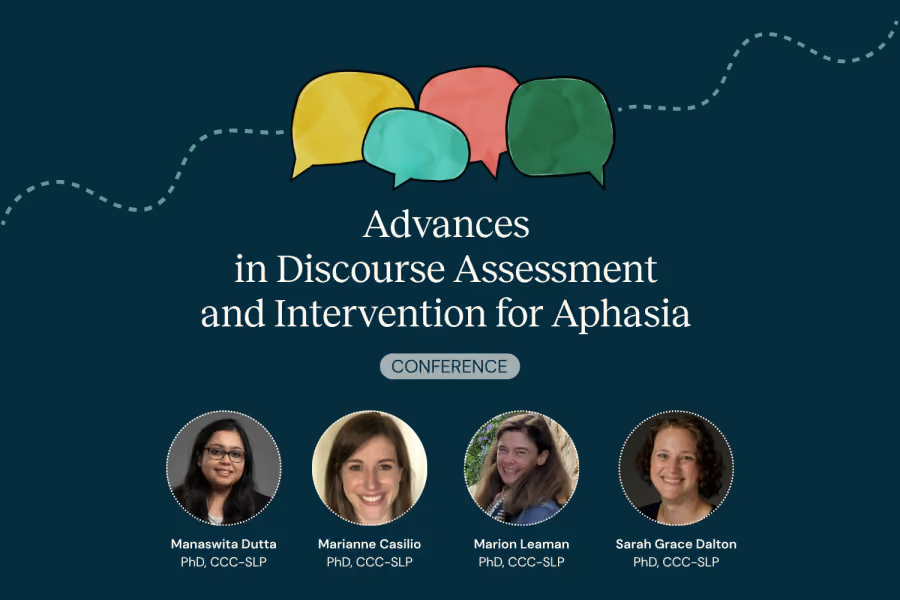
On June 7, Speech Therapy PD will host a full-day professional development conference, “Advances in Discourse Assessment and Intervention for Aphasia Conference,” for clinicians who want to build confidence using discourse in aphasia care. The course will feature four clinician-researchers whose work addresses practical, clinically relevant aspects of discourse-based assessment and intervention: Drs. Marianne Casilio, Manaswita Dutta, Sarah Grace Dalton, and Marion Leaman. The course will be moderated by translational researcher Dr. Brielle C. Stark.
Dr. Marianne Casilio: Clinical Evaluation of Connected Speech: Auditory-Perceptual Approach
Dr. Marianne Casilio will discuss Auditory-Perceptual Rating of Connected Speech in Aphasia, or APROCSA, a transcription-less system for rating connected speech features in aphasia. APROCSA addresses one of the most common clinical barriers: time. Instead of requiring a full transcript, trained listeners rate connected speech features such as paraphasias, reduced speech rate, agrammatism, and motor speech characteristics. For clinicians who want a structured but feasible way to describe connected speech, this work offers a promising bridge between research and practice.
Dr. Manaswita Dutta: Cross-Linguistic Perspectives on Discourse Assessment and Treatment
Dr. Manaswita Dutta will discuss bilingualism and linguistic diversity in discourse assessment. Her session will address how clinicians can choose discourse tasks, interpret bilingual language use, consider cultural and language experience, and avoid overly narrow views of what “successful communication” looks like. This is especially important for multilingual communities, where natural communication may involve multiple languages, code-switching, and context-specific language use.
Dr. Sarah Grace Dalton: Core Lexicon Discourse Analysis for Clinical Practice
Dr. Sarah Grace Dalton will discuss Core Lexicon analysis, or CoreLex, which examines whether a speaker uses expected key words for a particular discourse task. For example, when telling a familiar story or describing a picture sequence, certain words are commonly used by neurologically healthy speakers. People with aphasia may communicate the general idea but use fewer of those expected lexical items, affecting clarity, efficiency, and listener effort. CoreLex offers clinicians a concrete and efficient entry point into discourse assessment.
Dr. Marion Leaman: Using Conversation to Improve Conversation-ECoLoGiC Treatment
Dr. Marion Leaman will discuss work centered on conversation, one of the communication contexts many clients care about most. Her research has shown that language in unstructured conversation can be measured reliably and that performance in conversation does not always match performance on structured narrative tasks. Her ECoLoGiC-Tx intervention uses spontaneous, participant-led conversation while the clinician supports interaction, communication repair, and independence within a structured treatment framework.
Bringing Discourse Into Everyday Aphasia Care
For SLPs, discourse assessment and treatment invite a shift from asking, “Should I be assessing and treating discourse?” to asking, “How can I do this in a way that is meaningful, efficient, culturally responsive, and clinically realistic?”
Whether you work in inpatient rehabilitation, outpatient therapy, home health, private practice, a university clinic, or community-based aphasia programming, discourse is where communication becomes life participation. The June 7 Speech Therapy PD webinar offers an opportunity to explore practical tools, current research, and clinical considerations for bringing discourse more fully into aphasia care.
Register here









_1725825905820.avif)