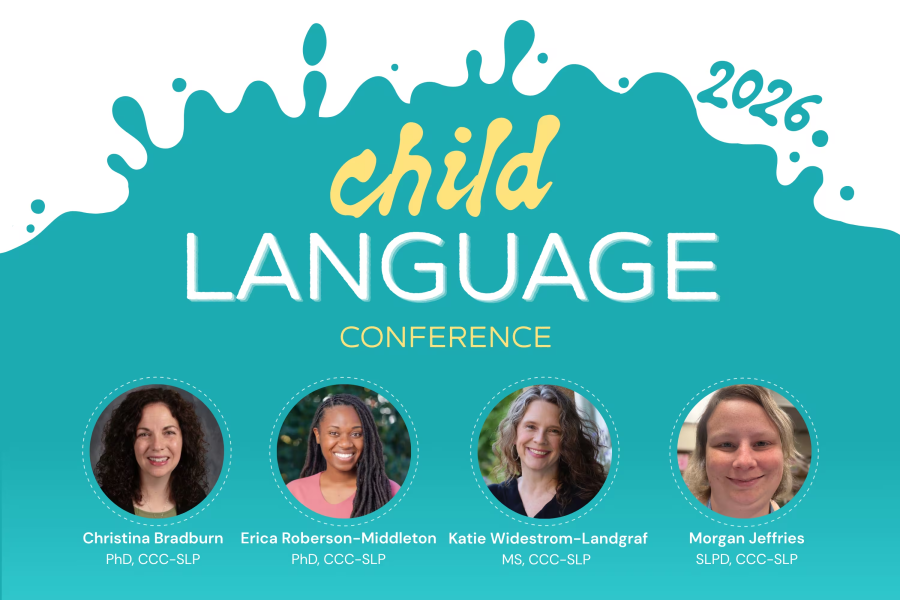





Speech-language pathologists (SLPs) play a critical role in identifying and treating language disorders across diverse pediatric populations, yet advances in research continue to reshape best practices for assessment and intervention. Join Christina Bradburn, PhD, CCC-SLP, Morgan Jeffries, SLPD, CCC-SLP, Katie Widestrom-Landgraf, MS, CCC-SLP, and Erica Roberson-Middleton, PhD, CCC-SLP, for four evidence-based presentations exploring current research, practical clinical strategies, and emerging topics in child language across school, medical, and community settings.
Participants will examine contemporary approaches to language assessment that extend beyond standardized testing by considering learning potential, responsiveness to intervention, and the influence of language, culture, and educational experiences on performance. The conference also explores developmental language disorder (DLD) in older children and adolescents, highlighting commonly overlooked characteristics and evidence-based strategies that support more accurate identification, effective intervention, and improved long-term outcomes.
Attendees will also explore the history, evolution, and current use of African American English (AAE), developing a deeper understanding of language variation and generational linguistic change. These insights will strengthen clinicians' ability to distinguish language differences from language disorders and make culturally and linguistically responsive clinical decisions.
In addition, participants will learn practical ways to use visual supports to strengthen communication, language comprehension, executive functioning, and participation across a variety of learning environments. Strategies will focus on creating meaningful, easy-to-implement supports for children with diverse communication needs, including those who use augmentative and alternative communication (AAC).
Through current research, clinical case examples, and immediately applicable tools, this conference will help clinicians strengthen assessment, intervention, collaboration, and educational planning. Participants will leave with practical, evidence-informed strategies they can apply immediately to improve communication, participation, and outcomes for children and adolescents with language and communication needs.
Participants will examine contemporary approaches to language assessment that extend beyond standardized testing by considering learning potential, responsiveness to intervention, and the influence of language, culture, and educational experiences on performance. The conference also explores developmental language disorder (DLD) in older children and adolescents, highlighting commonly overlooked characteristics and evidence-based strategies that support more accurate identification, effective intervention, and improved long-term outcomes.
Attendees will also explore the history, evolution, and current use of African American English (AAE), developing a deeper understanding of language variation and generational linguistic change. These insights will strengthen clinicians' ability to distinguish language differences from language disorders and make culturally and linguistically responsive clinical decisions.
In addition, participants will learn practical ways to use visual supports to strengthen communication, language comprehension, executive functioning, and participation across a variety of learning environments. Strategies will focus on creating meaningful, easy-to-implement supports for children with diverse communication needs, including those who use augmentative and alternative communication (AAC).
Through current research, clinical case examples, and immediately applicable tools, this conference will help clinicians strengthen assessment, intervention, collaboration, and educational planning. Participants will leave with practical, evidence-informed strategies they can apply immediately to improve communication, participation, and outcomes for children and adolescents with language and communication needs.
Show more
Less