Medical Necessity, Educational Eligibility, and the Child Behind the Criteria
Examining the gaps between insurance coverage, school-based eligibility, and children's communication needs, and the shared responsibility of speech-language pathologists to help families navigate them.
Challenging assumptions about access to speech-language services
There is a common assumption among parents, medical providers, educators, and even speech-language pathologists (SLPs): if a child has a genuine speech or language disorder, health insurance will cover medically necessary therapy or the child's school will provide services. In reality, neither system is designed to address every speech-language need.
This was an assumption I once held myself, prior to working as both a hospital-based and school-based speech-language pathologist. My experiences across clinical settings have helped me recognize an important gap in how we educate families about access to care: a child can have a legitimate communication disorder, benefit from skilled speech-language intervention, and still not qualify for either insurance-funded therapy or school-based services.
Why a diagnosis doesn't always lead to services
Health insurance coverage depends on individual plan terms, exclusions, medical necessity criteria, and other requirements. ASHA notes that although outpatient speech-language pathology services are often covered by private health plans, some insurers exclude communication disorders with developmental or congenital origins (American Speech-Language-Hearing Association [ASHA], n.d.-a). Even when a plan covers speech-language therapy, restrictions may apply. A denial may reflect a plan exclusion, a medical necessity determination, an authorization requirement, or a limit on covered visits. Understanding the reason for a denial matters because the available next steps may differ.
School-based services operate under a different framework. Following a comprehensive evaluation, the school-based individualized education program (IEP) team considers whether a student has a disability, whether it adversely affects educational performance, and whether specially designed instruction or related services are needed for the student to make progress in the general education curriculum (ASHA, n.d.-b). A child may have a communication disorder without meeting the criteria for school-based services. Similarly, a child who qualifies for school-based therapy may have additional communication needs that extend beyond the scope of the educational program.
These decisions reflect different criteria, not a universal determination of whether a child has a communication disorder or could benefit from intervention. Medical necessity, insurance coverage, and functional communication needs are related, but they are not interchangeable. An insurer may determine that a service does not meet its coverage criteria, or a school team may determine that a student does not qualify for educational services, even when communication difficulties affect everyday life.
Eligibility for a particular service is not the same as the existence of a communication disorder, and the absence of coverage does not, by itself, establish that intervention is unwarranted.
Our ethical responsibility to families
When we recognize that children can have legitimate communication needs without qualifying for services through insurance or their schools, what is our ethical responsibility? Is it enough to identify a disorder and explain why a child does not qualify for a particular service, or do we also have a responsibility to ensure that families understand their options? If we have knowledge that families may not have, are we ethically obligated to help bridge that information gap?
ASHA's Code of Ethics provides a useful starting point for considering these questions. Principle I, Rule B states that professionals shall use every resource, including referral and interprofessional collaboration when appropriate, to ensure that quality service is provided. Principle III addresses our responsibility to act honestly and provide accurate information to the public, including information about our professions and professional services (ASHA, 2023). These provisions do not explicitly require every SLP to explain every possible service pathway, nor can they guarantee that a family will obtain care. However, they provide an ethical foundation for considering how we communicate with families when the services available through one system do not meet a child's needs.
ASHA's Scope of Practice in Speech-Language Pathology identifies education, counseling, advocacy, outreach, and collaboration as important aspects of professional practice. It also recognizes the role of SLPs in educating consumers about communication disorders and speech-language pathology services (ASHA, 2016). These responsibilities support helping families understand their options and identify appropriate next steps.
Our responsibility is not to guarantee access to every service or to become experts in every system. It is to communicate honestly about the limits of our own settings and help families identify appropriate next steps whenever possible.
Three systems, three distinct responsibilities
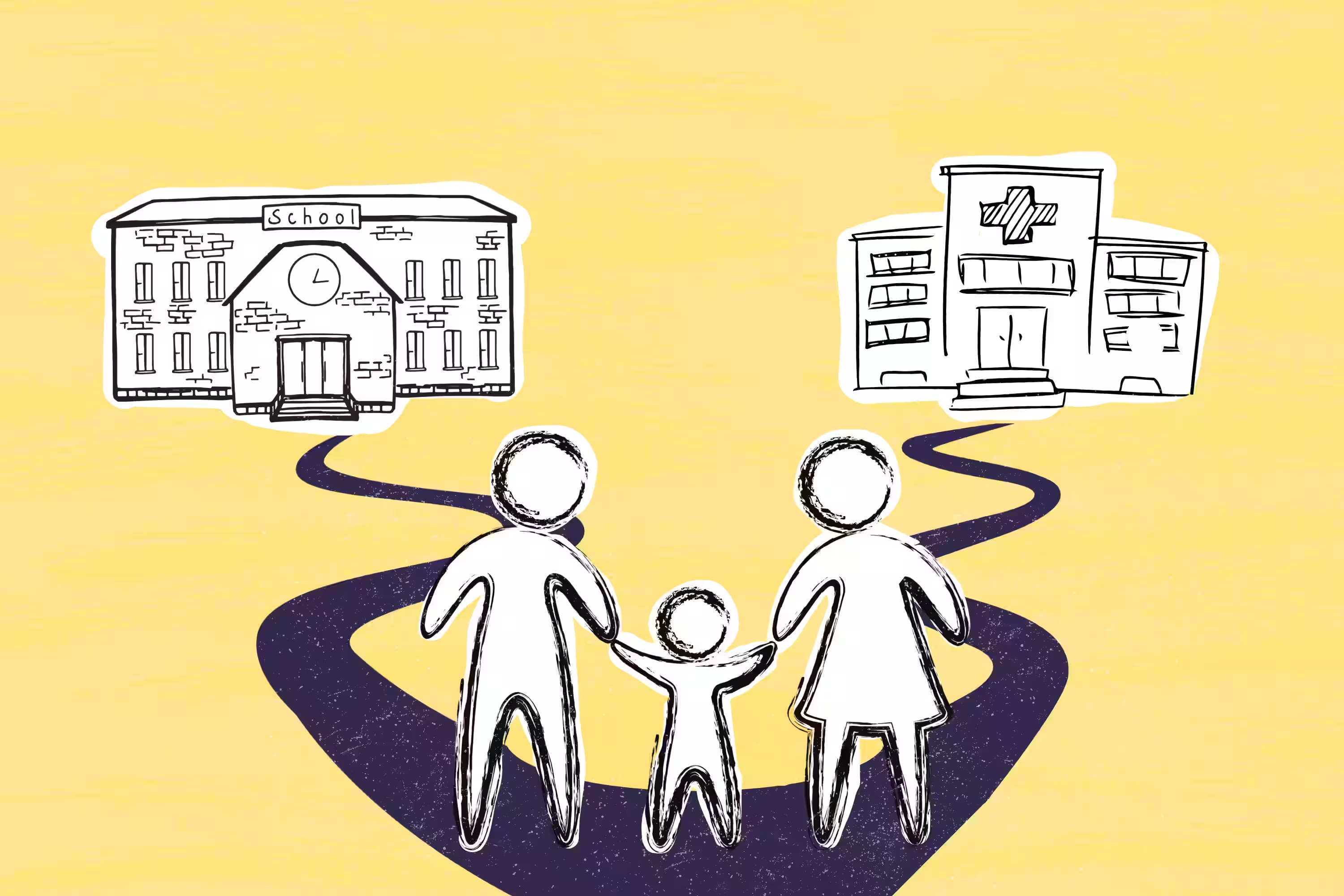
Medical providers, school-based SLPs, and private-practice SLPs each play a role in helping children access appropriate communication services. Although their responsibilities differ, they share an opportunity to educate families, clarify available options, and support informed decisions about care.
1. Medical providers: Recognizing need and explaining options
Medical providers are often among the first professionals families consult when they have concerns about their child's communication development. They can help families access evaluations, understand the significance of identified concerns, and explore appropriate treatment options.
When insurance denies coverage or a child does not qualify for medically funded services, families should not be left without guidance. Medical providers can explain that a school-based evaluation may still be appropriate and that a lack of insurance coverage does not necessarily mean a child's communication needs have been fully addressed.
Families may also benefit from contacting their insurance provider to clarify whether a denial relates to plan exclusions, medical necessity criteria, authorization requirements, or other coverage limitations. Understanding the reason for a denial can help families decide whether to pursue an appeal or explore other service options.
Medical providers do not need to be experts in every aspect of speech-language pathology reimbursement or educational eligibility. They can, however, help families connect with professionals who can explain the options available to them. A referral should open a pathway to care, not simply end the conversation.
2. School-based SLPs: Clarifying educational eligibility and connecting families with resources
School-based SLPs help families understand what an educational eligibility decision means for their child. Under the Individuals with Disabilities Education Act, school eligibility involves a comprehensive evaluation and consideration of disability, its effect on educational performance, and the need for special education or related services. Educational performance is not limited to academic achievement; it must be considered on a case-by-case basis (ASHA, n.d.-b).
When a child does not qualify for school-based services, families may need help understanding that decision and identifying other resources. Not qualifying for school-based therapy does not mean that a child has no communication disorder or would not benefit from intervention.
When clinically appropriate, school-based SLPs can encourage families to explore an outpatient speech-language evaluation and discuss the possibility of insurance-funded or private-pay treatment. A clinical SLP can assess the child's communication needs from a different perspective and determine whether intervention outside the educational setting is warranted.
The same consideration applies when a child already receives school-based speech-language therapy. The school program may address communication goals related to educational access and participation, while other needs may warrant additional clinical consideration. Outside therapy is not automatically necessary for every student, but it may be an appropriate option when a child's needs extend beyond the scope of school-based services.
With appropriate consent and in accordance with applicable policies, collaboration with outside providers can also support continuity of care and help families understand how services may address their child's needs across environments.
3. Private-practice SLPs: Providing care and helping families navigate the system
Private-practice SLPs provide assessment and treatment while also helping families understand the options available to them. This includes explaining the importance of verifying insurance benefits, discussing potential coverage limitations, and clarifying that a clinical recommendation does not guarantee insurance reimbursement.
Private-practice SLPs should not assume that families understand their insurance benefits, know how to pursue school-based evaluations, or realize that other service options may exist. For example, a child with a speech sound disorder may benefit from clinical intervention while also being appropriate for a school-based evaluation. Another child may have communication needs that warrant treatment but do not meet school-based eligibility criteria. In either situation, the SLP can explain potential pathways without promising insurance coverage or school eligibility.
When insurance does not cover a recommended service or school-based therapy is unavailable, private-practice SLPs can discuss private-pay options and other available resources. They can also help families understand when a school-based evaluation may be appropriate, even if the child is already receiving clinical therapy. Families deserve transparent information about costs, coverage limitations, and alternatives so they can decide what is feasible for their circumstances.
Across all settings, professionals should distinguish eligibility for a particular service from the presence of a communication need. Medical, educational, and private-practice settings operate under different criteria and serve different purposes. A decision made within one system should not automatically determine whether a child may benefit from evaluation or services through another.
Private-pay speech therapy: A necessary response to gaps in care
Ideally, every child who needs skilled speech-language intervention would have access to appropriate services regardless of their family's financial circumstances. In reality, insurance coverage and school-based eligibility requirements can leave some children without access to recommended treatment.
Private-pay speech therapy is not an ideal or accessible solution for every family. Out-of-pocket costs can create a significant barrier, leaving some families unable to pursue recommended care. However, private-pay services can fill an important gap when insurance-funded and school-based services are unavailable or insufficient to address a child's needs.
When a communication disorder is identified and skilled intervention is clinically warranted, the absence of coverage does not eliminate the child's needs.
Private-pay speech therapy can help fill this gap, but families should not be left to discover this option on their own. Medical providers, school-based SLPs, and private-practice clinicians all have opportunities to help families understand when additional services may be appropriate and what pathways are available.
A call for a more connected continuum of care
Insurance-funded services, school-based therapy, and private practice serve different purposes. Families may need to navigate more than one system to find services that address their child's communication needs.
A more connected continuum of pediatric speech-language care begins with clear guidance and communication among professionals. Medical providers can help families explore referrals and clarify coverage questions. School-based SLPs can explain educational eligibility and share information about community resources when appropriate. Private-practice SLPs can discuss treatment options, potential coverage limitations, and whether school-based or insurance-funded pathways may also be relevant.
No single provider or setting can meet every communication need. By sharing information when appropriate, respecting professional boundaries, and communicating with families and other providers with proper consent, we can help families make informed decisions about care.
Communication affects a child's ability to build relationships, participate in everyday activities, advocate for themselves, and express their wants, needs, thoughts, and identity. Families deserve clear information about their options, even when the path to services is not straightforward.
We cannot assume that families have the knowledge we have gained through our professional training and experience. Although we cannot guarantee access to every service, we can help families understand their options and avoid interpreting a lack of coverage or eligibility as a lack of need.
The question is not whether one professional can solve every barrier to access. It is whether we are doing enough, individually and collectively, to make sure families know where to turn.
References
American Speech-Language-Hearing Association. (2016). Scope of practice in speech-language pathology. https://www.asha.org/policy/sp2016-00343/
American Speech-Language-Hearing Association. (2023). Code of ethics. https://www.asha.org/policy/et2023-00342/
American Speech-Language-Hearing Association. (n.d.-a). Private health plans coverage of services: Speech-language pathology. https://www.asha.org/practice/reimbursement/private-plans/PrivatePlansCoverageSLP/
American Speech-Language-Hearing Association. (n.d.-b). Eligibility for school-based speech-language services. https://www.asha.org/slp/schools/prof-consult/eligibility/