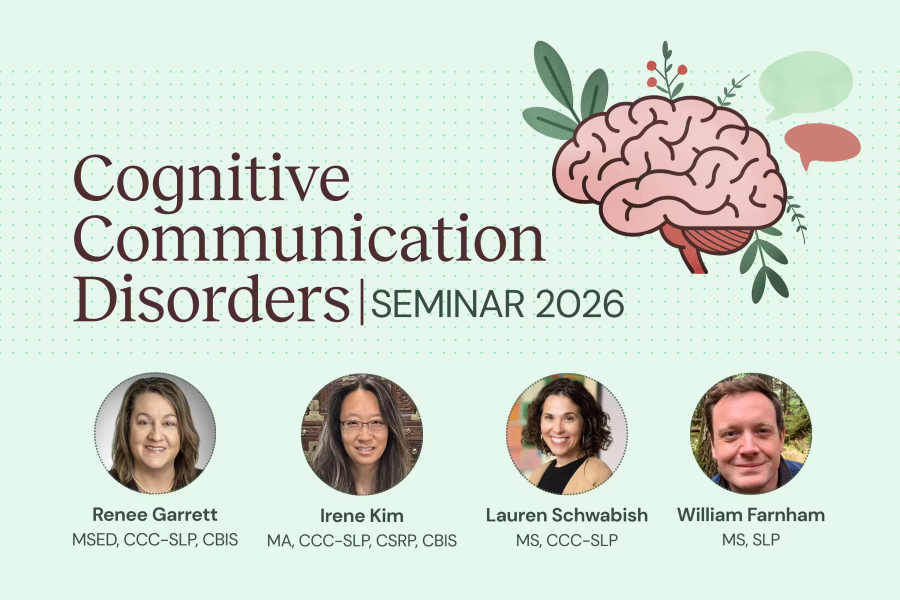





Neurologic conditions reshape communication, cognition, swallowing, and life participation in complex and evolving ways. Renee Garrett, MSEd, CCC-SLP, CBIS, Irene Kim, MA, CCC-SLP, CSRP, CBIS, Lauren Schwabish, MS, CCC-SLP, and William Farnham, MS, SLP present a practical, systems-based framework for evaluating and treating adults with dementia, brain injury, dysphagia, and aphasia across the continuum of care. This seminar bridges underlying pathophysiology with real-world clinical decision-making, helping SLPs translate neurologic change into meaningful, evidence-based interventions.
Participants will examine how neurodegenerative and acquired brain injuries affect cognition, communication, swallowing, and functional participation, and how these changes present across settings and stages of recovery or progression. Emphasis is placed on person-centered, functional practice, with a focus on anticipating patient needs, differentiating dementia subtypes and brain injury mechanisms, and aligning treatment with medical status, prognosis, and neuroplastic potential.
Through applied clinical examples, attendees will learn to develop participation-focused goals, integrate neuromotor and cognitive principles into swallowing assessment and treatment, adjust intervention plans as conditions evolve, support caregivers and meaningful life roles (including parenting with aphasia), and advocate effectively within interdisciplinary teams. Clinicians will leave with strengthened clinical reasoning and practical strategies to promote safety, participation, and quality of life for adults with cognitive-communication disorders.
Participants will examine how neurodegenerative and acquired brain injuries affect cognition, communication, swallowing, and functional participation, and how these changes present across settings and stages of recovery or progression. Emphasis is placed on person-centered, functional practice, with a focus on anticipating patient needs, differentiating dementia subtypes and brain injury mechanisms, and aligning treatment with medical status, prognosis, and neuroplastic potential.
Through applied clinical examples, attendees will learn to develop participation-focused goals, integrate neuromotor and cognitive principles into swallowing assessment and treatment, adjust intervention plans as conditions evolve, support caregivers and meaningful life roles (including parenting with aphasia), and advocate effectively within interdisciplinary teams. Clinicians will leave with strengthened clinical reasoning and practical strategies to promote safety, participation, and quality of life for adults with cognitive-communication disorders.
Show more
Less